


Share this post


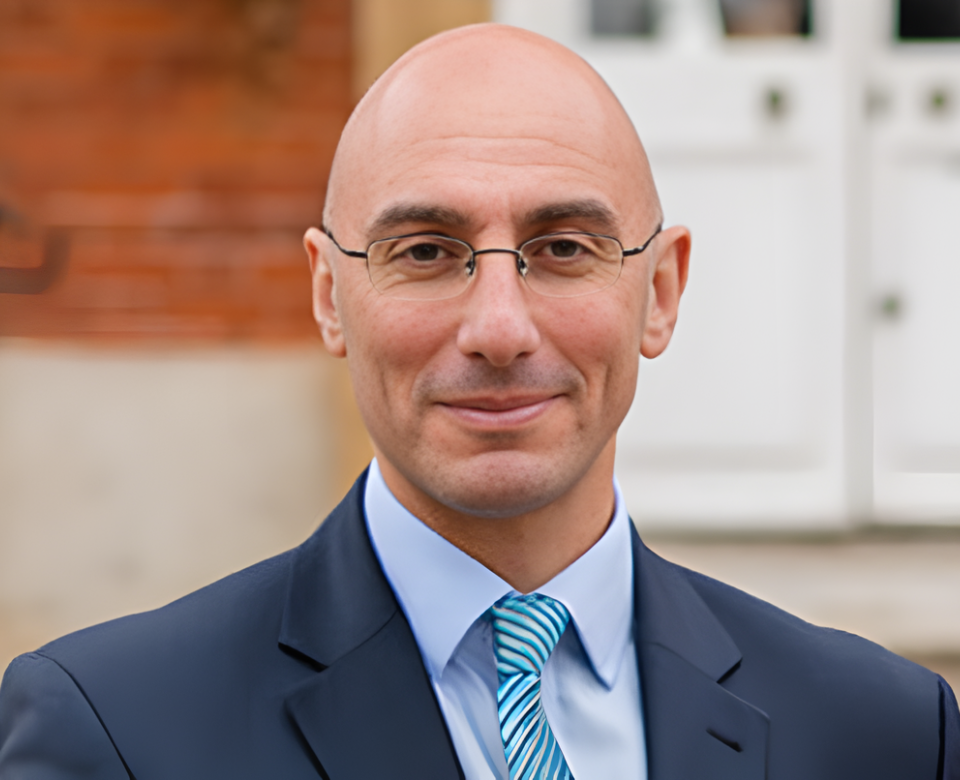
Leaders Profile interview with Kevin Cassar, AI and data leader
Meet Kevin Cassar: From chemical engineering to Chief Data and AI Officer at TalkTalk, Cassar reflects on building high-performance teams, navigating AI risk, and why “good leadership” means empowering others to succeed without you.
As soon as I log onto the call with Kevin Cassar I notice a bookshelf behind him lined with books on technology and data science. One title stood out immediately: AI Snake Oil: What Artificial Intelligence Can Do, What It Can’t, and How to Tell the Difference. It feels like a fitting detail for someone whose job revolves around separating real value from hype in the fast-moving world of AI.
Cassar laughs when I mention it, explaining that his idea of downtime often involves reading about emerging technologies and the future of AI. It is clear that curiosity has been a constant thread throughout his career; one that has taken him across industries including telecoms, insurance, finance and regulation.
Today, Cassar is the Chief Data and AI Officer at TalkTalk, and he is clear about what the role entails. “The remit involves me understanding what are the collective objectives that we want to deliver,” he says. “Increase profitability, increase customer satisfaction, and improve the data foundations that we have.”
But as our conversation unfolds, it becomes clear that Cassar’s job is not just about data infrastructure or algorithms. It is about people, and the ability to bridge the gap between technology and the rest of the business.
Mission possible: speaking every language in the C-suite
One of the biggest misconceptions about data leadership is that it is purely technical. In reality, Cassar says the role requires constant translation across the organisation.
“The CDAO role is not an easy one,” he explains. “You need to learn to speak the language of the different C-suite executives.”
“If you see a CFO, your language is finance… If you're the Chief Operating Officer, similar story, your operations, risk incidents, etcetera. But if you're a CDAO, you need to work with the Chief Finance Officer to help improve the PNL costs… If you're working on operational efficiency, then you need to speak the chief operating officer language.”
The constant context-switching is central to building trust across the organisation. “We need to be able to swap between the different languages and pitch the data products in the language of someone else. And that's when you start to build trust and relationships.”
Building high-performing teams
Despite the technical nature of his work, Cassar says his first focus when entering a new organisation is always the people.
“The first move I do… let's do a stock taker of the people, their skills,” he says. “I always lead with the people first, because I think that is the most important element of it.”
For him, technology and infrastructure come later. Without the right team and skills, he explained that even the most advanced tools will not deliver results.
“You can have the most shiny objects and the best data in the world—nothing gets done.”
That philosophy has followed him throughout his career. At AXA, where he previously led the health data science team, Cassar oversaw initiatives that delivered significant commercial impact. “Within my teams, we delivered a double digit million PNL impact,” he says. “That's direct PNL impact…through the data products which we delivered.”
But the numbers only tell part of the story. Cassar is equally focused on developing people and creating teams that can operate independently. “A good leader is one that empowers their team to function without them,” he says. “When the teams can continue to deliver and develop… that's when I say I really achieved my goal.”
The leadership style that keeps on adapting
Ask Kevin Cassar how he leads and he will not give you a single answer. In fact, he believes the biggest lesson he learned over time is that leadership cannot be fixed to one approach.
“One thing which I learned… is that there's no one strict leadership style.”
Instead, he shifts between different styles depending on context. “With my C-suite colleagues, I take the servant leader approach… How can I help you solve your business problem?” he explains.
In other situations, particularly when aligning expectations, he becomes more transactional. “If you outline this business problem, I'll commit to giving you this data product, but then you need to commit to using the outputs to deliver this value.”
When it comes to his teams, mentorship becomes the priority. “So throughout the conversation…I take more of a mentorship leadership style rather than a dictatorship.”
For new team members, the flexibility can be a bit confusing at first: “They might think that I'm confused or maybe I'm not coherent,” he admits. “And then when they work with me for six to 12 months, it's like, well, actually, this really makes sense.”
Why culture (and go-karting) matters as much as capability
Technical skill alone does not build strong teams, culture does. And for Cassar, that includes something some leaders may overlook: fun.
He recalls an early experience during his time at the Financial Conduct Authority (FCA), when he was unexpectedly asked to lead a data analytics team primarily focused on dashboards.
Initially, he was frustrated. “I was a bit frustrated at first… it's just going from this high profile to… dashboards and analytics.”
But he quickly changed his mindset. “I was like, look, I'm with this team. Let's have fun… let's help them and upskill them.”
The shift involved coming up with team-building activities and informal moments that helped build trust. “We went go karting together as a team away day… we worked hard, but we also liked that.”
The result? A highly motivated team that later delivered award-winning work.
“Life is hard as it is,” he says. “Sometimes jobs get busy. So… inject a bit of fun.”
Knowing when to say “no” to AI
In an industry often driven by hype, one of the hardest decisions for a data leader is to reject a technically impressive solution. Cassar did exactly that.
In one case, a proposed generative AI initiative promised to automate large parts of the customer journey. “The promise was huge… there was a lot of excitement with the C-suite.”
But when Cassar examined the proposal more closely, he became a little bit more concerned about its reliability. “When I started to dig a bit deeper into the solution, it wasn't as robust as people thought it would be.”
Telling leadership to pause the project was not easy. “Yeah, that didn't go down very well,” he admits. Evidence and transparency eventually won the argument. “I presented the facts clearly… Ultimately, we agreed to pause that piece of work.” Later, the decision proved to be the right one.
“When the dust settled, everyone was saying… I think we did make the right decision rather than sink in quite a lot of money.”
Now, as AI systems become more powerful, questions around responsibility and governance are becoming increasingly important. For Cassar, the key here is pragmatic balance. “In most cases, the human in the loop is still needed.”
Automation can dramatically improve efficiency, but fully removing human oversight is rarely the right move. “You use Gen AI… to surface and tell them for the human to make a decision. But that human in the loop needs to be there.”
What’s more, he believes that organisations hold AI to an unrealistic standard. “If you get two people, you give them the same information… they don't come to the same decision,” he says.
“So what is right and what is wrong and why is it that we accept the decision, while with AI we don't?”
From research labs to boardrooms
Cassar’s analytical mindset traces back to his early career in chemical engineering research.
It is a background that might seem unrelated to data science at first glance, but the mathematical foundations are surprisingly similar. “The way that gases move in them, you use partial differential equations, same as you do for neural networks,” he explains.
Research also taught him something that continues to shape his leadership philosophy: persistence. During his PhD, Cassar experienced two years of success followed by a year where nothing seemed to work. “People used to call me the Midas Kevin,” he says. “Because whatever I did was working.”
Then the luck ran out. “Everything I did in my final year… was just completely not working.” It was a lesson in resilience, and one he still applies today when tackling complex data challenges.
A legacy of helping others succeed
Towards the end of our conversation, I ask Cassar a final question: how does he want to be remembered?
His answer does not focus on awards, revenue impact or technical achievements. Instead, he steers it back to people. “What excites me is seeing people advancing their career,” he says.
“I don't do this for selfish reasons. I do it for selfless reasons.” And that philosophy extends beyond the workplace. Cassar volunteers his time to help charities and even mentor other professionals, something he views as paying forward the support he received earlier in his career.
“I was always lucky that I had good mentors that helped me to grow and evolve,” he says. “And it's my time to pay that back to the community.”
Quick-fire questions 🔥
What was your dream job growing up? I wanted to be an astronaut when I was a kid. I was fascinated with the stars.
What excites you about the next 12 months? So on Anthropic, there’s a focus on governance and ethics—thinking about ways we can deploy AR for the common people in a secure and safe manner. It’s really exciting to see that journey.
What do you do outside of work? I love to go for walks, especially by the sea or the countryside. It really helps my brain to calm down.
What’s your favourite music to listen to? I love to listen to classical music, especially guitar. I used to play the guitar when I was younger.
Best career advice you ever received? “Luck is where preparation meets opportunity.”

RELATED ARTICLES
Join the community
To join the HotTopics Community and gain access to our exclusive content, events and networking opportunities simply fill in the form below.