

.jpg)
/Doug.png)
Share this post


How CEOs and CIOs drive value from transformation
Business transformation is at the forefront of every CEO’s mind. But transformation programmes, each complex and unique to each organisation’s intricacies and objectives, are not without difficulties.
Boardrooms are increasingly grappling with mounting geopolitical pressures, subsequent macroeconomic turbulence, an influx of both AI excitement and fatigue, and the differing demands of shareholders, stakeholders, customers, employees and regulators.
Yet, as discussed at a recent HotTopics Food for Thought in partnership with SAP, people and processes are often perceived as bigger barriers to transformation than the technology itself. Five key barriers to transformation emerged from the discussion:
The five biggest business transformation challenges
-
Consistent communication of the transformation vision and benefits
-
Balancing strategic thinking with practical constraints in technology investment
-
Processes can’t keep pace with AI enthusiasm
-
Poor visibility undermines business transformation
-
A lack of clear goals impacts the measurement of business transformation
The HotTopics Food for Thought: Making business transformation legible
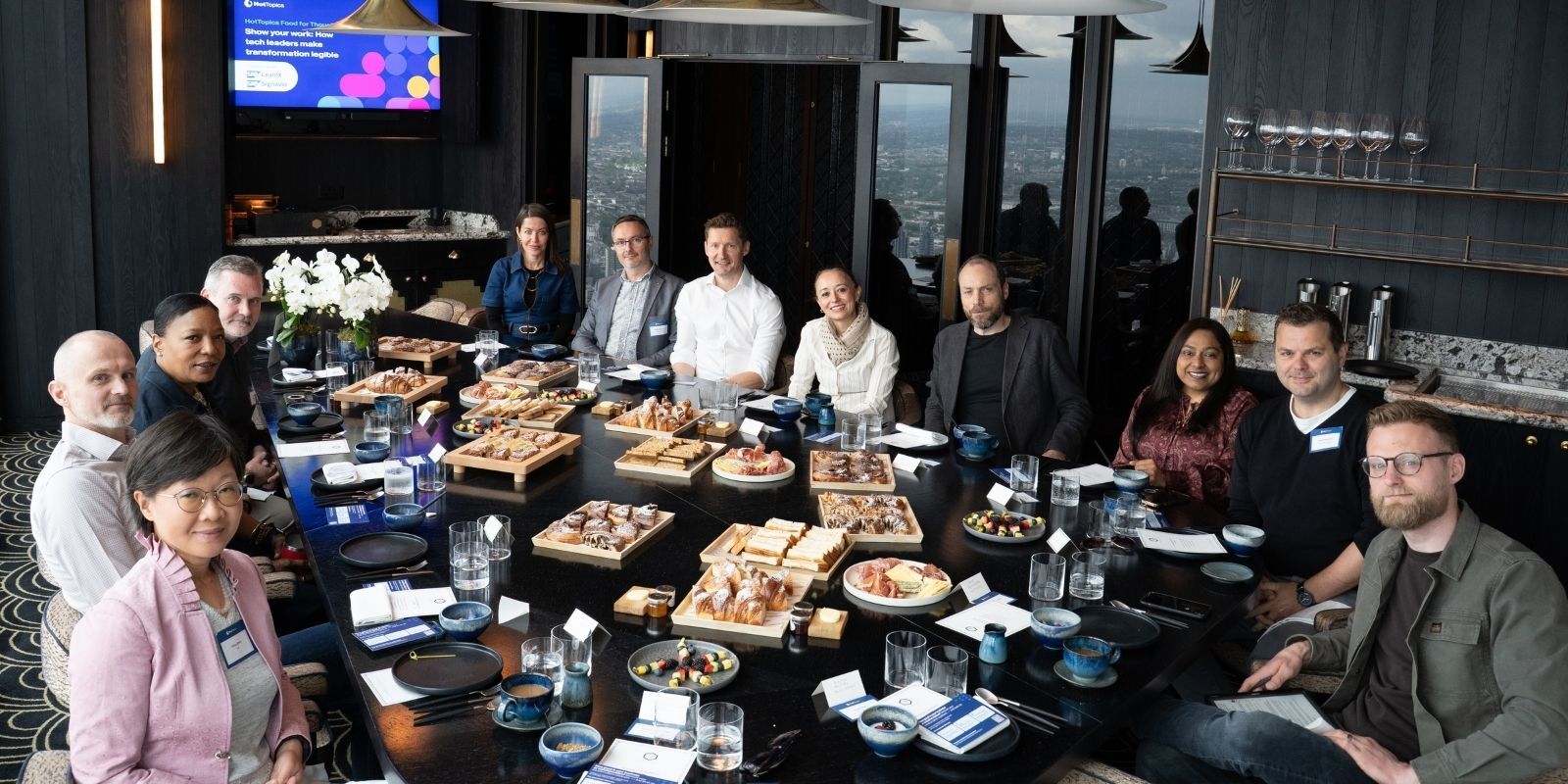
Senior technology and business leaders across multiple sectors gathered with HotTopics and SAP to talk about business transformation, AI and why organisations must have the right vision, strategy, visibility and measurement into transformation programmes which are often costly and mission-critical.
This HotTopics Food for Thought was hosted by Doug Drinkwater, an experienced technology journalist and editorial and strategy director at HotTopics, and attended by the following executives under Chatham House Rule:
- Norma Dove-Edwin, Group CTO Strategy- digital, data, AI lead, L&G<
- Pablo Dimenza, senior managing director, Omnicom
- Dominic Redmond, CIO, PageGroup
- Gerald Hentschel, CIO, Western Union International Bank
- Jeffrey Wood, deputy director of ICT, The Princess Alexandra Hospital NHS Trust
- Mariana Reis, head of data, principal data manager, Experian
- Rajan Mistry, director, risk services technology leader, Barclay Payments
- Fabiana Fernandes, senior director, technology optimisation, Elsevier
- Yiting Shen, global head of external network, Citi
- Mauli Tikkiwal, Group CIO, CWS HY International Group
- James Sandham, director of digital & AI transformation, Omnicom
- Ashay Koparde, VP, solutions architect, Barclays
What emerged was a candid conversation pinpointing five key blockers to business transformation and enterprise agility.
Consistent communication of transformation vision and benefits
At the start of this Food for Thought, attendees faced two probing questions; if they themselves thought that technology was a strategic enabler of the business and, perhaps more pertinently, if that view would be supported by their CEO.
There was a mixed reaction - perhaps unsurprising given the array of industries in attendance and the differing levels of resources, investments, technological maturity and risk appetite.
But there was more than a hint that the CEOs themselves can be blinkered, caught up in short-termism at a time of mass market AI FOMO, increasing customer demands and the never-ending quarterly results treadmill. The consensus here was that an ability to look beyond the immediacy of today can differentiate the leaders from the laggards of business, and now AI, transformation.
“You need to have a bold CEO who actually has a vision,” said one executive. ”If you want to win with AI, you really have to imagine, or reimagine, the work you do and how you do that work - because it will be very different.”
There is of course a fine degree of nuance on what constitutes business transformation; at the HotTopics Studio at Abbey Road last month, a panel of other leaders and SAP mulled the idea of ‘big and little T’ of transformation; big T’s were structural changes to operating models, value creation and user behaviour; small T’s were platform changes, technology refreshes and incremental upgrades.
Both have their role to play, but require direction from the boardroom down. An example was given of an attendee’s prior CEO in the manufacturing industry.
“They had a very clear strategy… what is differentiating and what is non‑differentiating… and then 17 strategic objectives. That’s all he ever talked about."
The attendee would go on to add that this organisation’s share price increased significantly, not because the ‘engines were flying any faster’, but because he had a clear plan, which the organisation executed against every day.
And yet, not everyone is able to take strategy to execution; another attendee from the media industry spoke of programmes which had been running for years without quantifiable value, and of legacy attitudes and inertia stopping the firm from modernising.
This is not to say it is easy for CEOs to embrace change; indeed, as one observed; ‘How do you define the future state of an organisation in a world which is quite ambiguous?’
Balancing strategic thinking with practical constraints in technology investment
For digital, data and technology executives, positioning and perception have been continual challenges which have long shaped their ability to influence the organisation.
One must walk the line between encouraging innovation and maintaining control over the technology landscape. Too hands-off and the organisation runs amok with their own shadowy creations (which are thus unable to scale), too hands-on and your department quickly gets dubbed the ‘department of no’ slowing the organisation down, and killing any semblance of agility.
Market pressures can have an impact here; ongoing economic constraints can push tech functions back into basement order-takers, far removed from the leaders of business and AI transformation.
This plays out in new benchmark data from HotTopics: nearly 70% of global technology leaders identified themselves or their most senior technology executive as a Change Maker or Visionary Leader - and yet 81% also said that their organisation's top priority was operational efficiency and cost reduction; in other words, boards were hiring for transformation, but only seemingly willing to pay for maintenance. This pain is amplified by the emergence of AI, which is now in the hands of almost every employee.
“In advertising, the creative mind rules. But in the new world, it is about how you leverage technology to either speed that up, make things cheaper, or produce more for less - or with fewer people ,” said one executive, reflecting on technology’s positioning at the heart of AI transformation.
“There’s a battle between technology…and the business itself.”
Others reaffirmed this perception of technology once again being seen as a commodity, aided no doubt by legacy reporting lines, a crowded C-Suite of new AI, data and transformation roles, and the democratisation of AI which makes everyone an expert.
“We're basically still the naysayers and the policy makers.”
Underneath this however lies the ugly BAU activities which don’t worry the various business units taking to their favourite LLM. Cost control, data governance, skills and training are problems digital, data and technology leaders must solve to avoid wastage, regulatory scrutiny and drive genuine business impact.
Processes can’t keep pace with AI enthusiasm
As organisations rush towards AI adoption, many are discovering that process maturity remains a prerequisite for meaningful automation. Agentic systems may accelerate work, but they also expose inefficiencies, duplication and governance gaps which were previously hidden. Without process standardisation, and some degree of process intelligence, AI often scales inconsistency rather than performance.
“What we’re hearing from the market is that we have to adopt [AI], so we don’t have time to go through and change [the processes],” said one executive.
“Often I see people say, ‘We want to use AI to improve our process.’ But they’re just automating a bad process.”
Perhaps, as one attendee from the logistics sector noted, your customers don’t even want AI or automation, simply services that are reliably provided on schedule.
Leaders must modernise their workflows, kill redundant or zombie processes and redesign around real customer needs before plugging in AI.

Poor visibility undermines business transformation
Challenges around technology and process often boil down to the same thing: problems with real-time visibility into how the business actually functions.
Leaders can’t see which new or legacy technology systems they have, what underlying processes are at play, or where sanctioned (or otherwise) AI agents are gaining access to sensitive information.
This makes business transformation more of an art, than a science - and thus harder to quantify higher up the chain.
“We have AI everywhere ... .with a company that is very risk‑averse. The technology landscape is so vast and so complex we don’t even know what we have. There is a lack of visibility on what we need to focus on,” said one leader.
“One of the key words I hear everywhere is visibility. How do you ensure everyone has the information they need to drive transformation?” added Cliff Pennycate, EMEA team lead, strategic advisory - business transformation management at SAP.
“There are often technology teams who really understand the architecture, applications and sometimes even have the visibility of all of the AI agents available – but often don’t know how these are being used and adopted in the 'process world' i.e. by the business. Connecting technology and business process teams and breaking down the silos is critical for delivering successful outcomes”
A lack of clear goals impacts the measurement of business transformation
According to Gartner’s 2025 CIO Survey, only 48% of digital transformation initiatives meet or exceed business outcome targets. Separately, it has been reported that over 80% of business transformation initiatives fail to deliver against their original objectives, owing to a combination of projects falling out of scope, running out of time, or lacking the necessary resources.
Many transformation initiatives are hampered from the start, with a lack of definitive measurement being a key factor. Business cases are written, and quickly forgotten, with tech teams hitting project metrics that don’t move the P&L.
“Everybody’s good at implementing– but have you accomplished change if you’re not actually measuring? I have not seen this being done successfully anywhere,” said one executive.
"I’ve seen many examples where a business case for a transformation programme was created, but without defining a baseline of relevant and trackable KPI’s, thus making it extremely difficult to measure programme success in terms of business outcomes,” added Cliff.
“Saying ‘we’ve delivered the project on time' is simply not enough’,” said Cliff, adding that senior business executives are asking what business benefits the transformation programme has delivered.
“Leaders who transform well ensure they understand their baseline, thus have a means to track programme success and then move forward at pace. Do it once, then keep doing it — make transformation a continuous capability, not a one‑off programme.”
As this HotTopics Food for Thought drew to a close, the consensus was that transformation initiatives can only succeed through alignment and clarity. This only happens through clear objectives from leadership, real accountability for technology teams and an organisational design which views transformation not as a one-off, but rather a business capability able to run continuously and measure its impact from start to finish.
In partnership with

Explore SAP's Business Transformation Maturity Assessment and additional resources in The Orchestrators hub, in partnership with HotTopics.


Join the community
To join the HotTopics Community and gain access to our exclusive content, events and networking opportunities simply fill in the form below.