

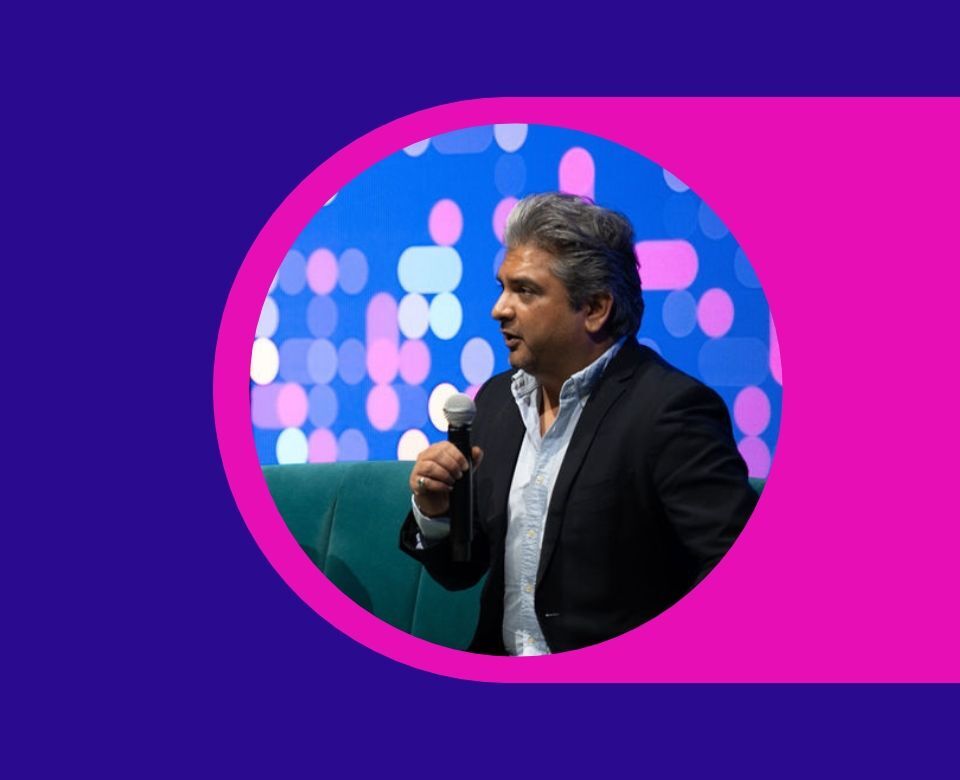
Leaders Profile: Amit Thawani, CIO at Lloyds Banking Group on leadership and enterprise AI

Kani Talabani
Share this post


Leaders Profile interview with Amit Thawani: Why leading with technology starts with being human.
After more than 25 years in financial technology, Amit Thawani has learned that the hardest part of transformation is rarely the technology alone. It is bringing people, technology, data and purpose together at scale.
Now Chief Information Officer for Consumer at Lloyds Banking Group, Thawani has spent his career leading major technology organisations through periods of change. Yet his philosophy on leadership remains remarkably simple: stay curious, stay connected to people and take accountability.
“As your responsibilities grow, leadership can sometimes feel more isolating because ultimately accountability sits with you. That makes staying connected to your people even more important.”
Thawani joined Lloyds Banking Group in October 2023 as Chief Information Officer for Insurance, Pensions & Investments before moving into his current role as CIO for Consumer.
His career spans more than 25 years in financial technology and has taken him across India, Japan, France, the Netherlands, Australia, Germany and the United States, working with organisations including Oracle, BNP Paribas, Wells Fargo and ING.
His experience encompasses major technology transformations, greenfield programmes, core banking modernisation, cloud adoption and increasingly the opportunities presented by data and artificial intelligence.
But working across different organisations, countries and cultures has taught him something more fundamental.
“We are all human. Cultures are different and you have to understand those nuances, but the fundamentals of leadership don't change. You need to listen, stay curious and have a genuine interest in people.”
For Thawani, technology leadership ultimately has a straightforward test: does it create a meaningfully better outcome?
“The measure of technology isn't simply how sophisticated it is. It's whether it makes something better for a customer or colleague, whether that's simpler, faster, safer or more accessible.”
Human-centric technology leadership: Staying connected at scale
When we spoke in June, Thawani was preparing to transition from leading approximately 2,000 people into a significantly larger role, with responsibilities spanning a workforce of around 10,000. As Thawani has taken responsibility for increasingly large and complex technology organisations, remaining accessible has become both more difficult and more important.
He encourages colleagues, from experienced engineers and senior leaders to graduates early in their careers, to engage with him directly. That accessibility creates its own pressures. A conversation in a corridor can easily overrun, while a message left unanswered can unintentionally undermine the openness a leader is trying to create.
But for Thawani, those interactions are not distractions from leadership. They are part of leadership.
“You need to have a genuine interest in people. Ultimately, people make or break a team.”
That philosophy also reveals itself in small interactions. He makes a point of recognising and speaking with colleagues across the organisation, irrespective of role or seniority.
For him, these moments matter because leadership begins with seeing the individual rather than the hierarchy.
“Leadership doesn't have to be complicated. It's about being human, staying human and genuinely caring about your people.”
But care does not mean removing accountability. Thawani believes the leader's job is to create the environment in which people can succeed, give them clarity and context, support them through difficult moments and ultimately take responsibility when things do not go as planned.
Leadership principles for CIOs: protect the team, hire for attitude
Some of Thawani's most enduring leadership lessons have come from observing other leaders.
A former Dutch manager once used the analogy of a pack to explain that leadership is not simply about being the person at the front. Strong leaders also remain among their people and pay particular attention to those at risk of being left behind.
Another manager demonstrated the same philosophy differently. Following an exceptionally difficult day at a contact centre, he arrived the next morning carrying doughnuts, pastries and treats for the team.
The gesture itself was small. Its impact was not. “He had enormous followership because people knew he cared. I've never forgotten that.” Those experiences have influenced how Thawani builds his own leadership teams. For him, capability is essential, but so too are attitude, curiosity, humility and the ability to work collectively.
“I don't want a leadership team that simply agrees with me. I want people who know things I don't, who challenge my assumptions and make the collective decision better.” It is an approach built around confidence rather than hierarchy.
Skills can be developed. The curiosity to keep learning, the humility to listen and the willingness to challenge constructively are much harder to manufacture.
Trust also needs to operate in both directions. Leaders cannot expect teams to make good decisions while withholding the context that allows them to exercise judgement.
“Scaling leadership requires more than delegating tasks. You need to give people enough context and trust to make good decisions without waiting for you.”
Transformation at scale: connecting technology to outcomes
For Thawani, the modern CIO increasingly operates at the intersection of technology, customer outcomes and organisational transformation.
Modernising complex technology estates, strengthening resilience, simplifying architectures, improving engineering effectiveness, unlocking data and responsibly adopting AI are not isolated technology agendas. They are connected elements of delivering better outcomes for customers, colleagues and the wider business.
This also changes the relationship between business and technology.
Rather than technology simply receiving requirements, Thawani believes successful transformation depends on shared ownership of outcomes, with technology leaders understanding the business as deeply as they understand the engineering.
That becomes particularly important as financial institutions explore the opportunities created by artificial intelligence.
Why enterprise AI is hard to scale in financial services
Thawani is optimistic about AI's potential to reshape financial services, but equally clear-eyed about the difference between experimentation and enterprise adoption. AI does not remove the longstanding importance of data. In many respects, it makes it even greater.
“People often say data is the new oil. I don't think that's quite right. Data only creates value when you can trust it, connect it, understand its context and use it responsibly to make better decisions.”
The same principle applies to AI. Creating an AI prototype is becoming increasingly accessible. Deploying AI safely and effectively across a major financial institution is a fundamentally different challenge.
“The real enterprise challenge isn't simply building the technology. It is scaling it safely, securely and responsibly, with the right data, controls and accountability.” In financial services, those considerations are critical.
Data confidentiality, security, accuracy, freshness, lineage, explainability, resilience and potential bias all need to be understood when AI is introduced into important processes, particularly where decisions affect customers.
An AI-assisted decision cannot simply become a black box. Organisations need to understand how important outcomes are reached, what controls apply and where human judgement and intervention are required.
For Thawani, the objective is not technology for technology's sake.
“Technology should augment human judgement and help us create better outcomes. The exciting question is not what AI can do on its own, but what people and technology can achieve together.”
How to govern AI agents: Execution, accountability and trust
During a recent HotTopics Studio panel, Thawani expanded on how Lloyds Banking Group is approaching the transition from AI experimentation towards enterprise execution through the use of AI agents.
A particularly important distinction, he explained, is that an AI agent should not be confused with a conversational interface.
“Agents are about execution. They don't just answer a question; they can act towards an outcome. And the moment technology begins to act, accountability becomes even more important.”
That shift introduces profound questions for technology and business leaders.
Who has authorised the agent to act? What data can it access? What decisions can it make? Where are deterministic controls required? What is monitored? When should a human intervene? And, critically, who remains accountable for the outcome?
Thawani believes enterprise adoption will therefore require a thoughtful combination of probabilistic AI capabilities and deterministic processes, particularly where established policies, risk parameters and regulatory obligations need to be observed.
Observability, explainability, security, intervention mechanisms and clearly defined decision rights consequently become central to the architecture, rather than controls applied after the technology has been developed.
But he is equally clear that responsible AI cannot be owned by technologists alone.
Leadership education, collaboration across business, technology, risk and control functions, and clear accountability are all necessary to give organisations the confidence to move from experimentation towards meaningful adoption.
Innovation may begin with an experiment or MVP. Enterprise transformation begins when the wider organisation understands what is changing, what outcome it is trying to achieve, how the risks will be managed and who is accountable.
Why leadership accountability matters
Despite his enthusiasm for AI and emerging technologies, Thawani repeatedly returns to the same underlying principle: technology should serve people, not the other way around.
His philosophy brings together technology modernisation, customer outcomes, responsible innovation and human leadership.
And one piece of career advice from a former manager has stayed with him throughout his international career:
“When it's success, it's for the team. When it's failure, it's yours.”
It is a deliberately simple leadership philosophy. Celebrate success collectively. Take accountability personally.
Whether leading a small team or a large technology organisation, Thawani believes the fundamentals remain remarkably constant.
Technology will continue to evolve at extraordinary speed. Leadership must evolve with it. But the responsibility to listen, care, remain curious and create an environment in which people can succeed will not disappear.
For Thawani, perhaps that is the paradox of modern technology leadership: the more powerful technology becomes, the more important being human becomes.
Key takeaways
- Technology leadership starts with people. Stay accessible, listen and create the conditions in which people can succeed
- Accountability belongs with leaders. Celebrate success collectively and take responsibility when things go wrong.
- Build teams that challenge you. The best leadership teams bring different perspectives and improve collective decision-making.
- Technology must connect to outcomes. Its real value lies in making things meaningfully better for customers and colleagues.
- AI agents are about execution, not simply conversation. As AI moves from answering to acting, accountability becomes increasingly important.
- Responsible AI at scale requires trust. Data, security, controls, explainability, observability and human oversight matter alongside the technology itself.
- AI governance is an organisational responsibility. Sustainable adoption requires business, technology and control functions to work together.
Quick-fire questions with Amit Thawani:
What was your dream job growing up?
I wanted to be an engineer from a young age. I was fascinated by how things worked and loved taking things apart to understand them
What keeps you up at night?
Whether we're moving quickly enough to create better outcomes for customers and opportunities for colleagues while continuing to earn the trust people place in us. Technology is changing incredibly quickly, and standing still carries risks of its own.
What excites you about the next 12 months?
The opportunity to lead through one of the most significant technology shifts our industry has seen in decades. AI will fundamentally change what is possible, but I believe the organisations that succeed will be those that combine technology, people, data and trust.
What do you do outside of work?
Outside work, you'll usually find me travelling with my wife and two sons, exploring new cultures, or in the kitchen. I'm also an avid reader with a keen interest in philosophy, history, global politics and, of course, technology.
Best career advice?
Be curious, be kind and be brave. Curiosity keeps you learning. Kindness builds trust. And courage helps you embrace opportunities before you feel completely ready.
Editor's note: This interview was conducted in June 2026, prior to Amit Thawani's appointment as Chief Information Officer for Consumer at Lloyds Banking Group. His current title has been reflected in this article.

RELATED ARTICLES
Join the community
To join the HotTopics Community and gain access to our exclusive content, events and networking opportunities simply fill in the form below.
