


Share this post



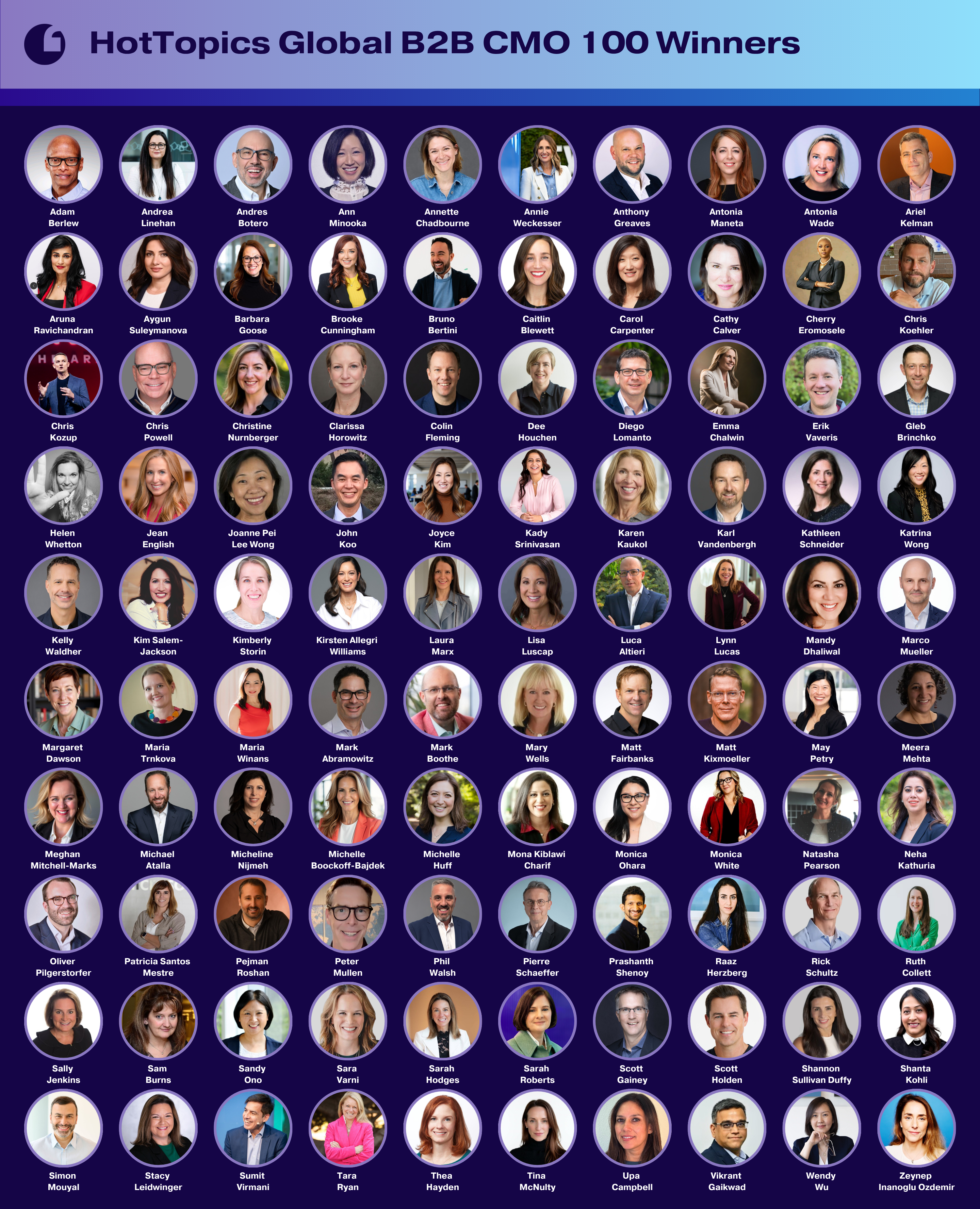
Learn key lessons from recipients of this years' HotTopics B2B CMO Top 100 Award.
Five B2B CMO 100 leaders reveal what is occupying their board meetings in 2026, from the race for AI-ready talent and proving ROI, to rebuilding brand relevance in an "age of abundant content".
Bring together five award-winning B2B marketing leaders and ask what is occupying their attention in 2026 and you might expect artificial intelligence to dominate the conversation. It did, although not quite in the way one might expect. Meet:
- Andrea Linehan, CMO, Supermetrics
- Andres Botero, Chief Marketing Officer, Horizon3.ai
- Brooke Cunningham, CMO, LogicMonitor
- Patricia Santos Mestre, EMEA Security GTM Lead, Microsoft
- Phil Walsh, Chief Marketing Officer, EPAM Systems
These five, brought together after their recognition in the HotTopics B2B CMO 100 2026, in partnership with Outreach, were already deploying AI across marketing. Some had agents running workflows. Others could point to productivity gains that would satisfy many a finance committee. Their concern had moved downstream: they needed the people to make it work.
“We’ve created these job descriptions for unicorns of people,” said Andrea Linehan, CMO at Supermetrics. Roles that might once have taken two or three months to fill were stretching to six or nine. When the right candidates did appear, she said, they could command 1.5 or twice the expected salary. The AI transformation of marketing, in other words, is moving into the operating model itself.
B2B marketing's new talent problem
There is ample evidence that Linehan’s challenge is not unique. Gartner’s 2026 CMO research found that 38 per cent of marketing leaders regard insufficient internal AI expertise and talent as the biggest obstacle to AI-driven efficiency. Labour’s share of marketing budgets, far from collapsing amid automation, actually increased from 21.9 per cent in 2025 to 24.5 per cent this year.
Yet scarcity only explains part of the difficulty. At Microsoft, Patricia Corsi described hiring processes in which the job itself could change before a candidate was appointed. “Things evolve so quickly that…even the scope changes a bit,” she said.
This makes recruitment an increasingly unusual exercise: companies are competing for capabilities while simultaneously working out which capabilities they need.
The consequences reach into management. Corsi recalled one Microsoft manager describing his team as “three, four hires” alongside 22 AI agents. She expects overseeing combinations of humans and agents to become increasingly normal.
Microsoft’s own 2026 Work Trend Index suggests the organisational machinery has some catching up to do. Just 19 per cent of AI users surveyed sit in what Microsoft calls the “Frontier”, where individual capability and organisational readiness reinforce one another. Its research found organisational factors such as management practices, culture, and talent accounted for more than twice as much reported AI impact as individual behaviour.
The question facing CMOs is less how to train marketers to use AI and more what a marketing job—and team—should look like when some of its productive capacity is no longer human.
What counts as proof anyway?
That creates another challenge. The things AI does remarkably well can also be remarkably easy to measure.
Brooke Cunningham, CMO at LogicMonitor, has evidence most executives would happily take into a board meeting. AI-enabled conversations across its website and outreach had booked 444 meetings without requiring a person to enter the conversation until the meeting itself, she said. LogicMonitor had also reduced the number of marketing development representatives in each region while producing what Cunningham described as roughly 254 per cent of pipeline with half the headcount. AI productivity targets now form part of her annual operating plan.
The numbers are impressive. They also illustrate an emerging measurement asymmetry.
McKinsey warned this year that many organisations are deploying AI in ways that are “more visible than valuable”. Six in ten organisations in its research had yet to see enterprise-wide EBIT impact from AI, despite widespread adoption. Faster work is comparatively easy to observe; proving how that improvement ultimately changes financial performance is harder.
Marketing knows this problem rather well. For Phil Walsh, CMO at EPAM, enterprise sales can take six, 12 or 18 months. A buyer may encounter the company dozens of times through different channels before revenue appears. “It’s all interstitched together,” he said.
The modern buying committee makes this messier still. Forrester’s State of Business Buying 2026 found that a typical B2B purchase now involves 13 internal stakeholders and nine external influencers, with participation increasing for more complex purchases.
HotTopics’ own B2B Marketing Benchmark 2026 found marketers responding with pragmatism rather than methodological purity. Businesses increasingly use several attribution models depending on the decision being made. Simpler systems survive partly because colleagues can understand and act on them. Its conclusion was striking: “Attribution succeeds not when it is most accurate, but when it is most usable.”
AI presents B2B CMOs with a curious bargain. It can make parts of marketing newly legible to the Board just as the wider customer journey becomes harder to reduce to a clean line of causation.
Authenticity, scarcity, and maintaining brand relevance
There is a further consequence or cost to abundance. If every marketing department gains access to increasingly capable tools, producing more digital material does little by itself to create distinction.
Andres Botero, CMO at Horizon3.ai, sees competitors replicate messaging almost instantly. His response was to re-engage with traditional marketing.
Around the Black Hat cybersecurity conference in Las Vegas, Horizon3.ai concentrated advertising at airports, around the Strip, in Ubers, and at the event itself. The ambition was simple: someone spending a week at Black Hat should keep encountering the brand. Digital retargeting then extended that physical context once attendees went home.
“I see branding resurging,” Botero explained.
Walsh, too, is experimenting with a related model at the rather different scale of EPAM: geographically targeted out-of-home advertising combined with digital ring-fencing and retargeting around priority accounts. The difficulty now is replicating such concentration across a business operating in dozens of countries.
This should not be read as a rebellion against digital marketing; rather, these are strategies to shape its context.
Oatly has been travelling in a similar direction. The Wall Street Journal reported this summer on its shift towards real-world beverage events and cultural experiences. Its global president described the company as digital-first, but “always blended with iconic culture-making life events”.
Perhaps this is one response to a marketing economy overflowing with cheap production. When another campaign can be generated in seconds and another message rewritten instantaneously, the scarce commodity becomes the physical, contextual, tangible experience surrounding it.
For these B2B CMO 100 leaders, that points towards a different phase of AI adoption. The tools are becoming easier to acquire (but harder to finance). The harder questions concern the organisation built around them: who is capable of doing the work, what evidence the business accepts as proof that it matters, and how marketing creates something worth remembering once production itself is abundant.
The competitive advantage has shifted from access to AI to the operating model surrounding it, meaning marketing leaders tasked with solving these are taking another step into the shoes of business leaders who happen to have marketing credentials.
Discover the leaders shaping the future of B2B marketing. Explore the HotTopics B2B CMO 100 to meet the marketing executives setting the agenda for the year ahead.


Join the community
To join the HotTopics Community and gain access to our exclusive content, events and networking opportunities simply fill in the form below.